| dc.contributor.advisor | Zarter, Gary H. | en |
| dc.contributor.author | Elmes, Charles David | en |
| dc.date.accessioned | 2025-04-07T20:24:59Z | |
| dc.date.available | 2025-04-07T20:24:59Z | |
| dc.date.issued | 1998 | en |
| dc.identifier.uri | archives.northwestu.edu/handle/nu/66653 | |
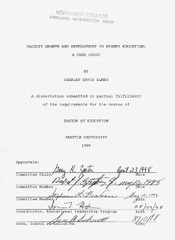
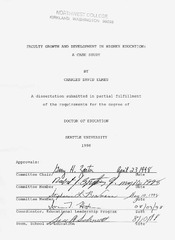
| dc.description | A dissertation submitted in partial fulfillment of the requirements for the degree of Doctor of Education. | en |
| dc.description.abstract | The purpose of this study was to explore the process of faculty growth and development in a four-year college using a case-study design. The design used a triangulation of methods, sources, and theories to accomplish its purpose. | en |
| dc.description.abstract | A survey, open-ended interviews, and the analysis of documents were the chosen methodologies. Full-time faculty, part-time faculty, current students, graduates, and administrators were the sources for the study. The review of literature was synthesized by using the theoretical constructs of organizational theory, ethical theory, and systems theory. In addition, faculty improvement programs and sociological paradigms were used in the analysis of specific documents. | en |
| dc.description.abstract | There was a 75 percent return of 223 surveys. Ten open-ended, follow-up interviews with ten questions each were conducted. Six core organizational documents and various faculty meeting agendas for the past two years were analyzed using a document analysis matrix. | en |
| dc.description.abstract | Theoretical triangulation produced the "what should be" of faculty growth and development. From the triangulation of the methods and sources emerged the "what is" of faculty practice and experience. As the "what should be" was compared to the "what is," answers to the identified research questions began to emerge. | en |
| dc.description.abstract | Some notable results include: | en |
| dc.description.abstract | 1. The average mean survey score for all statements by all participants was 2.85, which equates to a strong "agree" factor on the interpretative scale ("agree"=2.5 to 3.5); | en |
| dc.description.abstract | 2. The interview responses revealed dissonance between official statements and real behaviors and practice including expressed attitudes about a growth and development conducive environment; | en |
| dc.description.abstract | 3. The document analysis matrix indicated that the highest rankings were regulation sociology (14.9%), the structural frame (14.4%), organizational development (13.6%), and the felix (13.5%) and beatitudo (8.2%) levels of ethical realities. | en |
| dc.description.abstract | Research conclusions and recommendations for additional study bring this project to a close. | en |
| dc.description.tableofcontents | Introduction, p. 1 -- Review of literature, p. 10 -- Methodology, p. 77 -- Analysis and findings, p. 109 -- Conclusions and recommendations, p. 162 | |
| dc.format.extent | 208 pages | en |
| dc.format.medium | Paper | en |
| dc.language.iso | English | en |
| dc.publisher | Seattle University | en |
| dc.rights | This original work is protected by copyright. Copyright is retained by the author(s). Works may be viewed, downloaded, or printed, but not reproduced or distributed without author(s) permission. | |
| dc.rights.uri | http://archives.northwestu.edu/page/copyright | |
| dc.title | Faculty Growth and Development in Higher Education: A Case Study | en |
| dc.identifier.box | 112 | en |
| thesis.degree.name | Doctor of Education | en |
| thesis.degree.level | Doctoral | en |
| thesis.degree.grantor | Seattle University | en |
| thesis.degree.discipline | Education | en |

 Maintained by the Northwest University Library